
About Me
- tollysnomad
- With more than 50 years of travelling about in India, one can share a good deal of information and experience about out-of-the-way places and roads less travelled. That can make visits all the more exciting and enjoyable.
Sunday, 31 January 2021
Indian economic development - some fresh thoughts
There had been times when a GDP growth of 3.5 or 4% per annum in India was thought to be remarkable. Nowadays, people feel somehow disappinted if the growth rate registers 7.5% rather than 8%. There had been times when inflation had been over 25% in a year (and the people have had to live with it). Presently, even a 10% inflation rate is popularly unacceptable. For the Reserve Bank of India, the target is to keep inflation within about 6%. Gone are the times when one had to wait for days to get a cement permit sanctioned for building construction or even to make an outstation call to a relative or to queue for hours to get a berth reervation in a train. Now's the time for messages "at the speed ofight", with the wi-fi or "hot-spot" willing, on-line pruchases of most commidities, and on-line train reservations.
This did not happen overnight. But how did it at all happen? To get a glimpse of this, have a look at the book "Eco Yatra", published by Tata McGrawHill - this speaks of traversing the path of India's economic change for the last six decades. It tells the story of how this change took place over the last 60 years or so, when in 1952 Jawaharlal Nehru presented the nation with the First Five Year Plan with an investment plan of just Rs 2,070 crore (in comparison, the Tenth Plan 2002-2007 had an outlay of Rs 1,484,131 crore). It sifts through hard economic data, while bringing out the broad trend lines, without losing sight that economic development also has an underlying human dimension. Thus, at one level, the book traces the changes that impacted the people at a human level; at another, it takes the reader past the major milestones on the road to economic change over the last 60 years; not in a bookish way, but as a chronicle of national and individual aspirations and achievements.
 Copies of the book are available with Amazon. Check at -- -- https://www.amazon.in/Eco-Traversing-Indias-Economic-Decades/dp/0070680698/ref=sr_1_6?dchild=1&qid=1612095758&refinements=p_27%3AProsenjit+Das+Gupta&s=books&sr=1-6

Friday, 15 January 2021
"Tracking Jim" - Notes on Jim Corbett, the famous hunter of man-eating tigers
The Corbett National Park, originally called the Hailey National Park when it was set up in 1930s, has been re-named after the famous hunter, Jim Corbett, who had lived practically all his life in the hills and foot-hills of Nainital in Uttarakhand. The family lived at Gurney House in Nainital in the summer months, coming down to the village of Kaladhungi (also called Chhota Haldwani), in the foot-hills, for winter. The Gurney House and the Kaladhungi bungalow have now been turned into museums in memory of the renowned hunter.
It was also in the neighbourhood of Kaladhungi that Corbett had his first initiation in the ways of the jungle under his elder brother, Tom, who was in the Indian Postal Service. Corbett has written of these experiences in his two books, "Jungle Lore" and "My India" though there are some glimpses also in his other books.
 Above is a picture of Gurney House, situated at Ayarpata, up on the hillside on the southewestern side of Nanital Lake.
And given below is a picture of Corbett's bungalow at Kaladhungi, which has now been turned into a museum by the Forest Dept., Govt. of Uttarakhand. Kaladhungi is siutated on the road almost mid-way between the towns of Haldwani and Ramnagar.
Above is a picture of Gurney House, situated at Ayarpata, up on the hillside on the southewestern side of Nanital Lake.
And given below is a picture of Corbett's bungalow at Kaladhungi, which has now been turned into a museum by the Forest Dept., Govt. of Uttarakhand. Kaladhungi is siutated on the road almost mid-way between the towns of Haldwani and Ramnagar.


Monday, 28 December 2020
Sunderbans- the story of Ban-bibi
The Sunderbans, at the south-eastern border of India and Bangladesh, is one of the largest mangrove forests in the world, spanning about 5000 square kilometres. This has also been been the scene of a long-standing man-tiger conflct, with a number of human deaths each year attributed to man-eating tigers. The Sunderbans are approachable by driving about a hundred kilometres to the south-east of the metropolis of Kolkata and then taking a mechanized boat from either Canning or from Gosaba.
 The fishermen and honey-collectors living in the area are great believers in prayers to Ban-bibi before entering the mangrove forests. Ban-bibi is said to have had a miraculous birth and is equally revered by the Hindu and Muslim people in that area. At about that time, "Dakhin-rai" was a despot who tried to maintain his rule by offering human sacrifices to the wild tigers inhabiting the mangrove forests. One day Dukhey (the very name suggests a "sorrowng one"), a poor fisherman was to be so sacrificed to the tiger, and he prayed long and earnestly to Ban-bibi for succour. The goddess answered his prayers and threated Dakhin-rai that she would put an end to his depradations. Dakhin-rai submitted to the goddess, who then took Dukhey on her lap and consoled him.
This legend is widely believed in the region and shrines to Ban-bibi may be seen at many places in the Sunderbans.
The fishermen and honey-collectors living in the area are great believers in prayers to Ban-bibi before entering the mangrove forests. Ban-bibi is said to have had a miraculous birth and is equally revered by the Hindu and Muslim people in that area. At about that time, "Dakhin-rai" was a despot who tried to maintain his rule by offering human sacrifices to the wild tigers inhabiting the mangrove forests. One day Dukhey (the very name suggests a "sorrowng one"), a poor fisherman was to be so sacrificed to the tiger, and he prayed long and earnestly to Ban-bibi for succour. The goddess answered his prayers and threated Dakhin-rai that she would put an end to his depradations. Dakhin-rai submitted to the goddess, who then took Dukhey on her lap and consoled him.
This legend is widely believed in the region and shrines to Ban-bibi may be seen at many places in the Sunderbans.

Saturday, 12 December 2020
"Dhokra Art" - Basic Facts
“Dhokra” is a common folk art form in India. This is widely practised in many tribal areas of India, but mainly in central India, such as in Madhya Pradesh, and Chattisgarh, as well as in Odisha, Jharkhand and West Bengal. This art-form for making castings in brass or bell-metal (these being varying compositions of copper, zinc and occasionally a bit of tin or arsenic) relies on the “lost-wax” process of casting.
The “lost-wax” process is so-called because the forms and designs are made in bees’ wax or some similar malleable materials that volatilizes and evaporates or is otherwise “lost” in the process of heating up the rough casting in a furnace.
The process starts with craftsman or artist making a rough clay figurine or shape, say of a horse or a bull, or some local deity, or a utility item like a candle-stand, as the core for the casting. This clay, usually from a river bank, is finely ground and sieved and then shaped and dried in the sun. The surface of this “core” shape is thoroughly smoothened and the craftsman proceeds to cover this fully with fine extruded threads of bees’ wax. Over this are placed the actual designs as diamond-or star-shaped or coiled arrangements in bees wax and the finer details of eyes, ears, clothing, ornaments, etc. (also in bees wax) are added on. This wax-coated core is then covered with clay, also finely sieved and of a soft texture, and allowed to dry in the shade for a couple of days. This is then coated with a thicker and coarser layer of clay mixed with rice husk, taking care that at one point, either at the top or bottom of the shape, an aperture is kept open with a couple of thin bamboo sticks. This whole is then again dried in the shade for a couple of days.
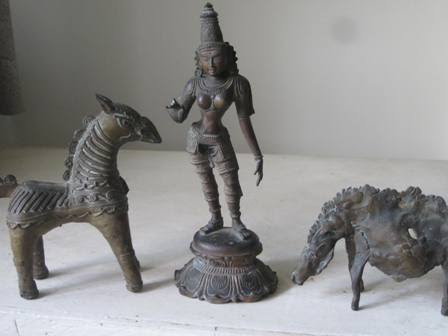
 The above photo shows three different types of "lostwax" art - the typical folk style, the South Indian statuette and modern art college piece.
It will be realized that with this process the wax designs made on the inner core have made for a gap of about 1.25 to 1.5 mm (i.e. the diametre of the extruded wax threads) with the other clay coating, carrying the imprint of the patterns and designs on the inner surface of the clay coating. The rough casting is then placed in the furnace together with a small pot carrying the brass or bell-metal scrap fixed firmly where the bamboo sticks emerge from the aperture. This whole is then heated in a furnace with the pot of scrap metal at the bottom and bellows are used to induce the furnace temperature to rise to more than 900 deg. C, which the melting point of brass. The bellows are kept going for an hour or an hour and half till the clay casing starts glowing yellowish red. With practice and experience the craftsman knows when to take the next step and this he does by clamping the red-hot piece with long iron pincers and swiftly turns it over so that the molten brass or bell-metal now flows down by gravity and occupies the space for the patterns and designs left on the inner clay core as the bees wax would have by now long volatilized and evaporated. The casting is allowed to cool in the shade for an hour or so and then outer clay casing is broken open and the final cast figure emerges. This is then cleaned with light brushing with an iron brush and further finished if required with a steel file.
Strange as it may sound, this same “lost-wax” process has been used also to make the famous “Tanjore Bronzes” in Tamilnadu as well as the well-known Benin Bronzes from West Africa. Of course, in such cases the clay core has been much smaller and the bees wax coating considerably thicker and smoothened over with fine iron implements. The finer details of eyes, nose, ears, hands etc, are usually later sculpted on the cast figurine with fine iron instruments and the figure finished with steel files, sand-papering and buffing.
The above photo shows three different types of "lostwax" art - the typical folk style, the South Indian statuette and modern art college piece.
It will be realized that with this process the wax designs made on the inner core have made for a gap of about 1.25 to 1.5 mm (i.e. the diametre of the extruded wax threads) with the other clay coating, carrying the imprint of the patterns and designs on the inner surface of the clay coating. The rough casting is then placed in the furnace together with a small pot carrying the brass or bell-metal scrap fixed firmly where the bamboo sticks emerge from the aperture. This whole is then heated in a furnace with the pot of scrap metal at the bottom and bellows are used to induce the furnace temperature to rise to more than 900 deg. C, which the melting point of brass. The bellows are kept going for an hour or an hour and half till the clay casing starts glowing yellowish red. With practice and experience the craftsman knows when to take the next step and this he does by clamping the red-hot piece with long iron pincers and swiftly turns it over so that the molten brass or bell-metal now flows down by gravity and occupies the space for the patterns and designs left on the inner clay core as the bees wax would have by now long volatilized and evaporated. The casting is allowed to cool in the shade for an hour or so and then outer clay casing is broken open and the final cast figure emerges. This is then cleaned with light brushing with an iron brush and further finished if required with a steel file.
Strange as it may sound, this same “lost-wax” process has been used also to make the famous “Tanjore Bronzes” in Tamilnadu as well as the well-known Benin Bronzes from West Africa. Of course, in such cases the clay core has been much smaller and the bees wax coating considerably thicker and smoothened over with fine iron implements. The finer details of eyes, nose, ears, hands etc, are usually later sculpted on the cast figurine with fine iron instruments and the figure finished with steel files, sand-papering and buffing.
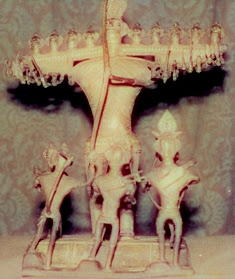
 This picture is of a traditional Dhokra item from Bastar in Chhattisgarh, of Rama and Lakshmana confronting the demon Ravana.

Wednesday, 2 December 2020
Sino-Indian Border Conflict - a view-point
Recently, Bookgeeks reviewed the book entitled "A Conflict in Thin Air" about the Sino-Indian Border Conflict. The review stresses the detailed research that went into thw writing of this book and the wealth of details about Tibet, China and British India that shaped the the origins of this conflict.
The link to the review is as follows - https://www.youtube.com/watch?v=4mbXnhg7RJ4


Tuesday, 24 November 2020
Iran - some more views
Iran has attracted me for many years, on account of a sense of cultural proximity, some degree of linguistic affliation, and of course, historical interactions.
But it was only in 2017 I was able to visit Iran with some friends but we had to get over the initial provblems of making out an itinerary, making foreign exchange remittance to make bookings, etc. Besides Tehran, we were able to visit the main cities like Shiraz, Isphahan, and lesser-known places - at least to the general tourist - of Yazd, Kashan and Qum.


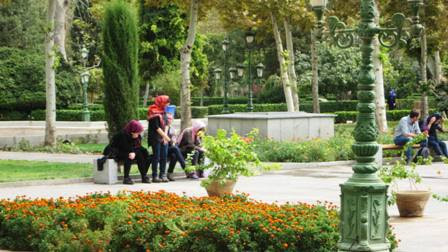
 These pictures (top two in Tehran) and bottom one in Shiraz) have been given to provide a glimpse about modern Iranian society and their interests and concerns: thety were as happy sitting in a garden or visiting a place of historical ietrest as any other.
 The above pictre was taken at the Nisar-ul-Milk Mosque in Shiraz and shows an Iranian lady taking a photo of the stained glass window.


Sunday, 15 November 2020
The Bathing "Ghats" of Kolkata
The bathing "ghats" are part of the cultural tradition in Kolkata. Situated mostly on the eastern banks of the River Hooghly, itself a branch of the holy Ganges, the "ghats" or the steps leading to the river, at times with nice pavilions to shelter from the sun, go back nearly three hundred years. These sites are shown in several of the old maps. This one is from Upjohn's map of 1794, showing some of the "ghats" to the north of the present city.
 The "ghats" are places where many people assemble for religious ceremonies on designated auspicious dates. A dip in the river is still considered to be part of a purification ritual. Many carry away a little bit of the river water to wash some part of their home or to use it for some household religious ritual.
 Several of these "ghats" are linked up with the history of Kolkata, such as the Prinsep Ghat named after James Prisep, who first decoded the Brahmi script of Ashokan edicts, oe Babu Ghat, named after the husband of Rani Rashmoni, who in the mid 19th century had bested the British admnistration on several ccasions.


Sunday, 8 November 2020
Dholavira - A Indus Valley Civilization site in India
The Indus Valley Civilization (or IVC for short) that grew up in the valley of the Indus River about five thousand years back, is well-known. Not so well-known is the fact that almost contemporaneously, sites similar to the well-known sites of Harappa and Mohenjo-Daro also grew up in parts of Western India. One such site is Dholavira near the town of Bhuj in Gujarat. It is at some distnace of about 220 kilometres to the north of Bhuj and it takes about four hours to drive up each way.
 The drive is quite pleasant especially in the morning in cold weather. The remarkable thing to be seen at Dholavira is the rain-water harvesting system with channels running down from the hillock down to the terraced water reservoirs at the bottom of the hillock, as may be seen in this picture.
The Local museum of artefacts recovered during the archaeological excvations at Dholavira is also inetresting.
The drive is quite pleasant especially in the morning in cold weather. The remarkable thing to be seen at Dholavira is the rain-water harvesting system with channels running down from the hillock down to the terraced water reservoirs at the bottom of the hillock, as may be seen in this picture.
The Local museum of artefacts recovered during the archaeological excvations at Dholavira is also inetresting.

Friday, 30 October 2020
Discovering Calcutta - A book now in Bengali
There are many books on Calcutta in both English and Bengali. Some deal mostly with the history, some are about a few of the well-known families of the city, some are on the Bengali cuisine, etc.
There is now - thanks to Ananda Publishers - a book that takes the reader around in easy-paced walks to discover the city for oneself.

This book, "Paye Paye Kolkata" (or, Walks in Calcutta) guides the reader along the main routes to see the city more fully, in its history, architecture, something of its social history, the eateries, and so many things. There are sections on old maps of Calcutta, the well-known sweet-meat shops, old paintings and lithographs, and so on. The book is available at most retail outlets, or from the office of Messrs. Ananda Publishers.
Wednesday, 21 October 2020
Orchids - Jewels of the Flower World
Flowers of the orchid plants have some of the most interesting shapes and colours that one can find in the plant world.
India has over 1200 orchid species growing in various parts of the country, out of which over 500 orchid species grow primarily in the Himalayan foothills at elevations of about 250 metres to about 2500 metres, and many of them in Northeastern India. Some of the best places to see orchids growing - some grow in autumn and many in spring and summer - is in in the Darjeeling Hills of West Bengal and in Sikkim, which is close by.

Aerides odorata

Dendrobium nobile

Rhynchostylis retusa
Some of these, especially the Aerides species, or the well-known Vanda roxburghi or the Rhynchostylis retusa are able to tolerate a good deal of heat and can grow even in the plains of central India. Many grow in Assam and in Arunachal Pradesh and other states of the Northeast.
Sunday, 11 October 2020
Yakshagana - folk theatre of North Karnataka
India has a rich heritage of folk theatre. These range from the "Chhau" of south-western West Bengal and northern Odisha to "Lai Haroba" in Manipur. And there is the colourful "Yakshagana" of North Karnataka, full of verve, vigorous dances and fine singing to the accompaniment of the traditional "chhenda" drum. The main centres are near Honavar and Bhatkal in North Karnataka, which may be approached by a 5 or 6 hour journey by train or vehicle from Bangalore or from Goa. A major teaching facility is of the Idagunji Mahaganapati Yakshagana Mandal.


Here, Shri Keremane Shivananda Hegde, who is the third generation teacher and performer, provides instructions in the intricacies of the dancing steps and movements as also in the hymns that are sung during the performance.
This theatre form seems to have emerged about 400 years ago, and is primarily based on themes taken from the Ramayana and Mahabharata. This is now performed not only in the big cities like Bangalore and Mangalore, but also is also very popular in the smaller towns, where travelling troupes, such as that of Idagunji Mahaganapati Yakshagana Mandal peform, mainly commencing with the winter season.
Tuesday, 6 October 2020
Bowali - An interesting Suburb of Kolkata
Bowali, which is a suburb of Kolkata on its south-western fringe, is historically notable. Approachable via Tollygunge, Behala and Bakrahat, Bowali at one time was the ancestral residence of the Mondal family that had large land-holdings in that area dating back to the 18th century. Even now, some of the relics of that age, such as the "Rasha-mancha" shown below, may be seen.


Tuesday, 29 September 2020
India - the economic scenario
The Covid-19 has cast a haze of doubts and confusion over the economic scenario in India. The restrictions necessary to combat the virus have severely impacted economic activity despite recent government efforts to revive the economy.
That laws, plans, and programmes do not lead to near-term results have been known for many years. Ever since the initiation of the Five Year Plans in India in 1952, the gap between promise and performance has persisted. In a country as large and diverse as India, opening of economic flood-gates does not ensure that the benefits will duly percolate to the individual farmer and farm-holding.

Partly this has been due to the growing population and partly because the basic realities of the wide-spread poverty and out-dated technology levels in many sectors, especially in agriculture. These issues were dealt with in the above-mentioned book and the need for political positions to take due account of economic realities was highlighted. Moreover even with the best of intentions, the complexities of implementation and management were not duly provided for, leading to severe economic road-blocks.
Wednesday, 23 September 2020
Bastar - Fade-out of a Tribal Culture
Bastar is a major part of the state of Chhattisgarh. It is to be reached from the rail-head of Raipur, by a drive of about 150-160 miles. One may also reach the main headqaurters at Jagdalpur by train from Vishakhapatnam that runs to Kirandul near the Bailadilla Hills; this train journey is picturesque with many high bridges and tunnels.
The population of Bastar was mainly tribals of Gond origin, such as the Muria, Bison-horn Maria, the Hill Maria, the Dhurwa, Poroja, and others. They were living in the hills and forests of Bastar, around the villages (now towns) of Antagarh, Kondagaon, Narayanpur, Jagdalpur, Dantewada and Sukma. It was a difficult life as the terrain is hilly and the soil stony. But they still had their songs, and dances, their arts and crafts. Their gods and goddesses like Burha Deo and Telgin Mata had their abode in the same hills and forests.


Monday, 21 September 2020
India Current Affairs - the Sino-Indian Border Conflict
Ever since the latest series of Sino-Indian border frictions started in May 2020, this has been much debated and discussed on the media. Even a couple of days ago, an overseas specialist who has done research on this topic implied in a major newspaper interview that the border problem is a product of British thoughtlessness in the matter.

To cross-check I went back to my book "A Conflict in Thin Air" published in 2016 by Cinnamon Teal Publishing. In this I could identify the treaties between India and Tibet or China on the following occasions - (a) Between Kashmir (then under the Maharaja, Gulab Singh) and Tibet in 1842, (b) Between Ladakh and Tibet in 1852, (c) the Cheffo Convention between Britain and China in 1876, (d) British India and China Treaty of 1890 setting out the configuration of the Tibet-Sikkim border, (e) the Simla Agreement of April 1914, which China signed and then repudiated and (f) the India-China Agreement on border trade in 1954. As to specifically about an understanding or appreciation about the border, I can only refer the scholar concerned to the several maps that British India produced from 1840s to 1890s, especially about Ladakh. At least 3 or 4 attempts were made by British India to have the Chinese authorities to agree to joint surveys from 1870s to 1920s but to no avail.

Thursday, 17 September 2020
"Patachitra" of Odisha
"Patachitra" is a folk art form of Odisha, practised mainly in villages near and around the temple city of Puri. A prime centre is the village of Raghurajpur that is about 20 kms from Puri on the way to Bhubaneswar and it can be easily approached from Puri by bus or vehicle or even train.
The word "patachitra" is derived from "pata" or plate or canvas, and was traditionally painted with oil-based colours on thin boards of wood, or on palmyra leaves, or on cloth. Patachitra as a folk art form seems to have started about a couple of centuries ago and has for motifs mainly themes based on Lord Jagannatha and Lord Krishna. Earlier it was done with a stylus on palm leaf but progressive it has come to be done with oil paints, mainly with primary colours of yellow, blue, red, green, with outlines finely etched with black, on cloth or wood.

This picture is of a patachitra item collected from Raghurajpur, sometime in 1990-91. It was done the famous patachitra artist, Jagannath Panigrahi, a national award-winner at that time.
Wednesday, 9 September 2020
Kumbhalgarh Fort in Rajasthan
Kumbhalgarh is located about 80 kms. from Udaipur town and boasts a grand fort that is said to have been constructed in the reign of Rana Kumbha of Mewar in the 15th century. Architecture of the Kumbhalgarh Fort is quite unique in that the outwardly bulging walls made it difficult for any invaders to approach closely. The name of Rana Kumbha is associated with several heroic deeds in the history of Rajasthan. It was here that Rana Pratap is said to have been born. The inner buildings are approached a number of high gates such as Bhairon Pol and Vijay Pol. The fort encompasses a number of temples such as the Neelkantha Mahadeo and the Parshvanath temples.


The length of the fortress walls runs for 26 kms. thus making it the second longest protective wall after the Great Wall of China. The width of the wall is also remarkable being about 5 mtres wide. It is certainly a grand spectacle.
Friday, 4 September 2020
Sino-Indian Border Conflict: a Historical Perspective - I
Excerpts from the book "A Conflict in Thin Air",on the Sino-Indian border conflict, published in 2016 by CinnamonTeal Publishing (also available through Amazon) --


This brief introduction to the geography and history of Tibet and China should help in a better understanding of the issues. The book of course gives a fuller exposition.
"Tibet, a vast plateau at an average height of more
than twelve thousand feet altitude in most places, straddles a large chunk of
Asia, bounded by the Himalayan mountain ranges to the south and pierced in
places by high passes like Lanak La, Shipki La, Mana, along the Himachal
Pradesh-Tibet and the Kumaon-Tibet borders respectively, the passes in Nepal,
and Nathu La, and Jelep La in the Sikkim Himalayas. The Karakoram mountain
range stands guard to the southwest of Tibet, the Kuen Lun range on the west,
the Koko-nor area and vast alkaline marshes on the north east and, a rugged
tangle of hills and forests mostly between ten and fifteen thousand feet on the
east bordering Yunnan and Szechuan provinces of China................Over the last thousand years or so, traders from
Kashmir, Bushairis from Himachal Pradesh, Bhutias from Kumaon, and the Nepalese
and Bhutanese traded across the high mountain passes for wool, salt (Tibet
having many saline springs and lakes), gold, borax and so on, while the Chinese
traders via Yunnan brought in great quantities of black tea that the Tibetans
were inordinately fond of. In turn, Tibetan traders came with their wares of
gold, silver, leather, and of course wool, into the marts of India and China

A view of typical Ladakh landscape
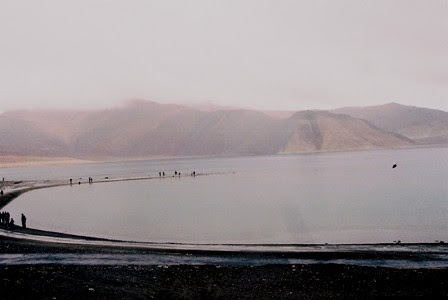
Pangong Lake in Ladakh - scene of recent skirmishes
I had visited Ladakh for sight-seeing in June 2013 and that as well as a chance discussion with a friend set me off to know more about the Sino-Indian border conflict. It took me over 2 years of research and going through about 70 books and several maps to get a grip on the subject. This resulted in my book on the Sino-Indian border conflict that is mentioned above.
Excerpt -- "At the core lay the long-standing Sino-Tibetan
animosities of over a thousand years. And, the persistent attempts of Tibet to assert its
independence with the equally persistent efforts by successive Chinese
administrations to enjoy the fruits of Mongol and Manchu imperialism since the
mid-13th century in Tibet, Sinkiang and Mongolia. Added to this was the
ups and downs of Tibetan and Chinese administration in the respective countries
since the 17th century (including outbreak of civil wars in the two
countries), the advances made by European and British imperialism in both China
and India, the Sino-Russian tussles in Mongolia, and of course, the “Great
Game” between Britain and Russia............... There have been quite a few books on the Sino-Indian
conflict of 1962, such as those by Neville Maxwell, Karunakar Gupta, S.R. Johri
and John Garvin (amongst others, besides those by Dalvi and Kaul) fairly well-known
to the Indian reading public. But, as my studies revealed, there were many,
many others, drawing upon extremely valuable archives and records that, together with
some basic histories of China and Tibet, help provide valuable insights and
perspectives on the whole issue of the “Why?” of it. I have seen those records
through the eyes and pens of renowned scholars such as Dr. Alastair Lamb,
Dorothy Woodman, Margaret Fisher and her co-authors, Parshotam Mehra, and those
of much earlier days, such as Charles Bell, E. Teichman, Robert Reid, T.
Richardson, L. Petech, and many others, whose names have been mentioned in the
Bibliography. Added to those should be the known and unknown surveyors of those
border areas, whose maps with their wealth of details are a joy to behold."
Tuesday, 18 August 2020
Jaisalmer in Rajasthan
As most people know, Jaisalmer is situated in Rajasthan right on the western border of India. It is well-known for its fort and the desert scenery nearby. It is connected by air and rail from the major cities like Delhi, Mumbai and Ahmedabad.

The Jaisalmer fort is truly magnificent and towers over the city. The golden-yellow sandstone with which it has built given a spcial glow in the early or late sun-light.
Inside it is equally impressive with beautifully designed pavilions and intricate carvings.

But it is the evening out in the desert together with a camel ride over the sand dunes that is most attractive to tourist.

Sunday, 14 June 2020
West Bengal - Terracotta temples
Terracotta, or unglazed fired clay products, is an ancient art form in India. It seems to have developed as an extension of pottery-making,
which is possibly the oldest craft practised by mankind after the making of
stone tools.
It was of course much later, possibly around 700 or 800 CE, when
temples began to be built in India that ways had be found to decorate the
temples with sculptures, and it was mostly in stone in those days.
Sophistication in temple architecture progressed with time and finer and more
elaborate carvings began to be made by the 15/16th centuries.
Yet
finer designs and in less time and less effort came with the development of
terracotta tiles to decorate temples with. Necessarily, terracotta generally flourished where stone for temple building was scare and clays were abundant, as found in the numerous river basins, such as the Kangsabati, the Damodar, Ajoy, Rupnarain rivers and of course the Ganga (Hooghly) in West Bengal. It was of course to some extent deliberate because of the ease and the sophistication of designs that could be made in clay relative to that in stone. This found a great flowering in the
late 17th, through the 18th and into early 19th
century. A good part of this now has become part of Bangladesh but a
great deal remains in West Bengal to be enjoyed in towns such as Bishnupur,
Kalna, Ilambazar, Guptipara and elsewhere in the Bankura and Midnapur districts
of the state. These sites are quite easily accessible from Kolkata by journeys of just three to five hours by bus, vehicle or train.

The "Jor-Bangla" temple in Bishnupur

"Raghunath" temple in Ilambazar

A hunting scene on Jor Bangla

A detail with Shri Krishna in Shyam Rai temple, Bishnupur
As
the above illustrations indicate, the motifs for the sculptures in the
terracotta are diverse, ranging from the secular, such as wars and royal
hunts, to the common devotional theme of Shri Krishna with the gopinis in
Vrindavan. Tile after terracotta tile is placed on the basic superstructure of
the temple, made here mostly of laterite blocks, to create a wonderful piece of
art.
Subscribe to:
Posts (Atom)