Travel notes for the interested traveler on places to see in Kolkata and its neighbourhood, out-of-the-way places and experiences elsewhere in India, glimpses of wildlife, folk art, tribal life and culture in India
About Me
- tollysnomad
- With more than 50 years of travelling about in India, one can share a good deal of information and experience about out-of-the-way places and roads less travelled. That can make visits all the more exciting and enjoyable.
Sunday, 26 June 2022
The Kinnaur Kailash in Himachal Pradesh - a fascinating journey
The month of October in 2012 saw me travelling with a group of friends to the Kinnaur Kailash region of Himachal Pradesh. The idea was to see some of the typical temples of that area besides making a visit to one the farthest outposts on the Indo-Tibetan border at Chitkul.
We went initially by train via Kalka and Simla and then by road up the valley of the River Sutlej via Rampur Busheir, at one time one of the key points in Indo-Tibetan border trade.
After night halts at Sarahan, Rekong Peo and Kalpa it was on to Sangla, and then up the valley of the Baspa River for a quick visit to Chitkul, which was at about 11,000 feet.
All along the way, the scenery was extremely beautiful, with snow-clad peaks showing up at almost every turn of the road, above and beyond the jagged hill ridges along the river valleys.
This was also the season for apples and other fruits, and one could pick them up from the road-side and fields with the permission of the land-holder, but only two or three at a time. Even baskets-full of apples were going cheaply in the local markets. An typical apple orchard may be seen below.
Considering the proximity of Himachal to the western edge of Tibet, it is small wonder that Buddhist "gumphas" and temples to Hindu gods and goddesses have co-existed in Himachal for long. One of the most fascinating temples was that of Bhimakali at Sarahan, with its unique architecture the picture of which is given below.
Another interesting temple was the Narayani at Kalpa. Of course, Chitkul, which was almost at the end of the valley of the Baspa had a special attraction.
So, this Kinnaur Kailash trip with its mix of wonderful scenery, excellent views of the Kinnaur Kailash from Kalpa, temples and plenty of fruits will be remembered for many years.
Friday, 10 June 2022
Bird-watching in Sattal, Kumaon Hills
A recent visit to Sattal, in the Kumaon Hills, located about 20 kilomteres from Nainital, for bird-watching was most enjoyable. While there are a number of lodges in the town (more a large village), the accommodation at the Kumaon Mandal Vikas Nigam was very central and not crowded at all. More to the point was the ease of access to some of the birding areas in and around Sattal. One of the notable features was the trusting nature of the birds in the neighbourhood. One Grey-winged Blackbird practically came upto my feet and was photographed with a 25 mm lens from about 4 feet away.
The White-throated Laughing Thrush was equally trusting (though laughing thrushes are generally quite suspicious of men) and came and sat on a branch of a tree near my head.
It is possible that a person sitting still does not usually disturb the birds and animals. Here a barking deer, normally a shy animal, stood at a distance of about 20 feet, without feeling nervous. This experience was quite enjoyable.
Tuesday, 3 May 2022
Corbett Tiger Reserve - Rare viewing of elephants
The Corbett Tiger Reserve in Nainital district, Uttarakhand, is one of the best places to see Indian wildlife in one of the finest natural settings.
The Park authorities in recent years have imposed restrictions on entry of private vehicles and have limited even safari vehicles registered with the Park authrities to about 25 or 30 every morning and afternoon at each of the four or five entry gates now functional. Further, entry permits may only be obtained "On-line" on the Tiger Reserve web-site on payment of the necessaey charges.
Looking for a tiger at Corbett is more like searching for a needle in a hay-stack - it is largely a matter of luck, although having an experienced guide and safari driver certainly helps.
Our trip to Corbett yeilded two tigers - but only just, as one was at some distance in some thickets and the other disappeared quickly in the grassland.
Our luck with the other big game at Corbett, the elephant, held and we saw a magnificent male elephant with heavy tusks leading the way for our safari jeep for over a kilometre.
The next afternoon, we had a rare viewing of about twenty-five elephants in another area of Corbett - such large groups are not be frequently seen. They frolicked in a large water-hole with the baby elephants nearly submerging themselves in the water, the others spraying water over themselves and all having a good time - much like children at a sea-side!
Needless to say, one does not come by such sights every day and we enjoyed taking pictures of these elephants almost as much they enjoyed themselves in the water in the heat of the afternoon!
Monday, 28 March 2022
Darjeeling Himalayan Railway - A UNESCO Heritage Site
One of the fascinations of childhood on any visit to Darjeeling in North Bengal was the ride in the "toy train". A toy train it was with its narrow-gauge track just two feet wide. The small engine would huff and puff as the driver and helper would shovel coal into the small, tub-sized boiler. Strange-sounding stations would pass - Rongtong, Tindharia, Ghayabari, Tung, Sonada and then Ghum, in the middle of a rising mist that entered through the door-way and exited through a window. Great moss-laden trees and masses of fern would brush the coaches as the train chugged on. All the while local people would hop on and hop off as if riding a tram car. It is nice to know that the Darjeeling Himalayan Railway, or DHR, has been accorded UNESCO "World Heritage" status in 1999.
As is well-known the Darjeeling region came under the British administration in 1850 and the first tea garden began to to be set up in that area around 1858. While the "Hill Cart Road" had been built by about 1858, it was another twenty years before the setting up of a railway line was thought of. The Darjeeling Himalayan Railway was the first, and one of the most outstanding, example of a hill railway in India, the other two being in the Nilgiris in South India and in Kalka in the north. Opened in 1881, the DHR as it was popularly known was a marvel of design and engineering, in tackling a rise of about 2400 metres over a distance of about 88 kilometres, i.e. about 1: 25. This the train could do by way of a number of zig-zag reversing-forwarding and three loops, where the track looped around and went over a small bridge over the track it had just covered. Despite these measures, it was interesting that two persons usually sat at the front end of the ngine, throwing handfuls of sand on the tracks to improve the traction.
Now all the steam engines that had been built in the UK by Sharp, Stewart and Co, and later North British Locomotive Co. have been retired and the coaches are presently hauled by diesel operated engines built at the Chittaranjan Locomotive Works.
It was therefore very much a journey through "memory lane" recently to visit that area after so many years and to see the DHR still chugging its way around the loops and zig-zags and the tourists thoroughly enjoying themselves with the novelty of the experience. And certainly the names of Rongtong and Tindharia rang a bell. That felt good.
Sunday, 27 February 2022
Some reflections on Ukraine
The recent invasion by Russia into Ukraine is most regrettable, and distressful on account of the inevitable loss of valuable human lives and the long streams of refugees.
One is driven to ponder over whether in the second decade of the 21st century when the Planet Earth is facing the serious challenge of Climate Change besides the task of building up a more inclusive, equitable and humane society it is at all relevant and pertinent to hark back to Tsarist or Stalinist days that date back for more than a century. How does one really turn the clock back?
Here the silver lining lies in rational and reasonable thought that human beings are still capable of, as exemplified by the address of the Kenyan ambassador to the UN at the UN Security Council on 25th February as per the link given here --
https://www.youtube.com/watch?v=78ec1_fzepc
There have been many bilateral and multilateral peace treaties in the past only to have some one tear them up for some real or perceived grievance. India also had to suffer such aggression more than once in the last 70 years.
https://www.bookgeeks.in/a-conflict-in-thin-air-prosenjit-das-gupta-book-review/
The Treaty of Versailles after World War I was no better, lasting for just about 20 years. At least the UN Charter that is subscribed to by over 200 countries has kept the peace for nearly 75 years.
Thursday, 20 January 2022
Indian temple sculpture - social media in stone
It is fortunate that most Indian temples have sculptures of people at work or play, or about music and dance, or in some rituals, etc.. In the absence of the art and science of photography, which did not exist in those early times, it is from such sculptures that later historians can draw some sort of idea about the nature of dressing, ornaments, buildings and architecture, mode of transport, dancing, the plants and vegetation, presence of kings and many other things, of much earlier times.
Secondly, religion even in the ancient times, was not always confined to sages living in caves and forests, but was a part and parcel of everyday life. So even a place of worship, such as a temple was decorated with scenes from real life, such as music and dancing, or of battles, or royal processions, or a king sitting in court, etc. This will be evident from tyhe pictures from Khajuraho and the Konarak temples given here by way of illuatrsation.
Thirdly, it is possible that these beautiful carving also attracted the common folk to come to the temple to pray and also to enjoy the interesting carvings.
It was was form of permanent visual copmmunication
Sunday, 16 January 2022
Farm Laws Re-visited
Recently there was an interesting Webinar on the Farm Laws that have been repealed following protracted oppostion by many sections of farmers. The principal speaker expressed the view that government was intervening in many ways into the demand, suppy, prices, etc. in the farm sector, which would be better left to market forces and the pricing mechanism to sort out.
There were quite a number of questions put to the speaker, these broadly concerning -- (1) certain specific provisions of the Farm Laws that appeared contrary to the usual provisions for legal review; (2) whether with the imperfect knowledge about the supply and demand situation, the price mechanism would work well; (3) how would the farmers or the purchasers factor in uncertain weather conditions especially with extrme weather conditions due to Climate Change; (4) whether issues of rural indebtedness and strengthening of the rural credit network deserves due consideration; (5) whether the form of corporatization envisaged in the Farm Laws was the right way forward considering the huge numbers of small and marginal farmers in India, and so on.
The Webinar provided a useful opportunity for exchange of views on an important subject. While the principal speaker attempted to deal with these wide-ranging issues, it did seem at the end that there were a good number of unanswered questions on the Farm Laws.
Sunday, 19 December 2021
Deben Bhattacharya - ethno-musicologist par excellence
Songs are the spontaneous human expressions of joy, invocation, sorrow or longing. They are the repositories of human emotions and of diverse cultural histories. One person attempted all his life to collect these fragments of the human experience from the desert, hills and rivers and piece together a shared heritage.
He was popularly known as "Deben: The gypsy from Varanasi". He was Deben Bhattacharya, born in December 1921 in a traditional Bengali Brahmin family in Varanasi where he studied in a traditional Sanskrit “tol”. After considerable vicissitudes he was able to travel to London and after odd jobs rose to become an associate producer of Indian music for BBC radio programmes.
For the next fifty years he devoted his time and energy to recording the folk music of different countries, from Romania, to Jordan and Syria, Mauritania in North Africa to Rajasthan, Bengal, Assam and Bangladesh on the Indian Sub-Continent.
His area of interest and passion were the songs of the desert, hills and rivers. The range of the work of the late Deben Bhattacharya, as much as an ethno-musicologist as that of a humanist, may be understood from (a) some of his films, e.g. "The Cosmic Dance of Shiva", "Painted Ballads of India, Krishna in Spring", "Faces of the Forest - The Santals of West Bengal", "The Mirror of the Sky, 1969 (the songs of the BAULS of Bengal for UNESCO", "Love Songs of Vidyapati", etc.; (b) the audio recordings - Bedouins of the Middle East 1955-60; Sounds of West Sahara – Mauritania; Maqams of Syria, River Songs of Bangladesh, The Mirror of the Sky – Songs of the Bauls of Bengal and so on. He was one of the first to have recorded the songs of Bauls of Bengal in 1956/57 and of the chants at the Buddhist monasteries.
The last Deben Bhattacharya has left an irreplaceable patrimony of intangible heritage of several nations. December 2021 marks the Centenary of Shri Deben Bhattachraya.
Further particulars of his works may be seen at --
https://www.sublimefrequencies.com/products/625798-deben-bhattacharya-paris-to-calcutta-men-and-music-on-the-desert-road
https://mubi.com/films/la-musique-selon-deben-bhattacharya
https://www.goodreads.com/book/show/859487.The_Mirror_of_the_Sky
There are several other sites also featuring the work of the late Deben Bhattacharya.
Fortunately his collection of about 400 hours of folk music recording and many thousands of photographs are now housed in the Bibliotheque Nationale in Paris.
Monday, 13 December 2021
Re-visiting Synagogues in Kolkata - and an interesting find
Several families of Sephardim Jews from Iraq came to the city of Calcutta shortly after the advent of the British in 1757. Soon thereafter synagogues came up for both for their weekly prayers, periodic religious functions such as the "Pass-over" and social events like solemnizing marriages.
It was interesting recently to re-visit the Jewish synagogues still to be seen in Calcutta they were first visited - more than once - in 1985-86 when preparing for the book "10 Walks in Calcutta".
The above shows the cover of the Bengali edition of the book titled as "Paye Paye Kolkata" published in 2018 by Ananda Publishers.
The first synagoue to be revisited was the Beth-el Synagogue that had been built in 1856. This community of Jews provided an important link between the Jews in UK and Europe with those in the Middle East, e.g. Iraq and Sysria and Palestine and those farther east in South East Asia, upto Hong Kong.
This picture shows the interior of the Beth-el Synagogue.
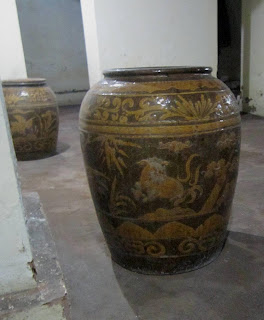
What was quite interesting was the wine cellar below the synagogue where wine that was used for certain ceremonies and made in the proper Jewish tradition had been prepared. Some of the jars for holding this ceremonial wine were evidently (as seen from the motifs on the jar) imported from China, which was known for long for its fine ceramics.
Following the visits to the Synagoues, there was time to visit a nearby Christian church and it was interesting to see this gravestone dedicated to one Sarkis de Agvally, who was from Armenia and Persia and had passed away in February 1736. It was evident that the Armenian community was among first of those from Europe who had settled down in Calcutta for trade and commerce.
The picture of the gravestone is as above.
Tuesday, 30 November 2021
Manas National Park - A re-visit after 35 years
The Manas National Park in western Assam has many feathers to its cap. It was among the "first batch" of Tiger Reserves in India way back in 1973.It is one of the very few wilderness areas in India that has been recognized as a UNESCO World Heritage Site, together with Kaziranga National Park (also in Assam) and the Bharatpur (or Keoladeo) Bird Sanctuary near Agra. Manas is also home to the endemic Golden Langur, the Bengal Florican and the Pigmy Hog, besides many other wild animals like the one-horn Indian rhinoceros, wild buffalo, tiger, gaur, elephant and many other species.
The Manas River (or the Beki, as it is called in the lower reaches - shown above) and the rugged hills of Bhutan to the north define the National Park to a signicant extent. Thus Manas offers a variety of wildlife habitats, from riverine forests, to heavy rain-fall and moist deciduous forests, besides extensive grasslands.
Over the years, Manas has witnessed ups and owns, but now the wildlife has made a good come-back. The local settlements have grown and Barpeta Road, once just way-station, is now a bustling town with fly-overs and shopping malls. A number of lodges have come up locally (where there were once only government rest houses), and a variety of facilities are on offer, including river rafting, wilderness walks and jeep safaris in the forest.
Manas National Park is conveniently accessible by train via the rail head of either New Bongaigaon or Barpeta Road, or by air from Guwahati City.
Thursday, 14 October 2021
Wet Bengal celebrates Durga Puja
The Durga Puja of West Bengal, the Navaratri of Northern and Western India and Dussehra in both North and South India coincide and is the cause of wide-spread celebrations. This marks the close of the Monsoons and the beginning of the harvesting season for rice. The Durga Puja combines the idea of Uma, the other name for Durga, returning to earth much as married daughters of the house return to visit their ancestral homes at around this time, and the concept of the victory of good over evil, exemplified by Durga slaying the demon, Mahishasur, on the day of Vijaya Dashami.
It all starts months earler with the making of the image of the goddess usually at the community-based making of such images at Kumartuli in North Calcutta.
This picture above shows the finished, regular "daker saaj" or the traditional image of the goddess Durga as she is invoked at the celebrations. Another image from some older temples where worship of the goddess takes place on a regular basis, given below, is somewhat different.
Rural Bngal also participates fully in the celebration of the Durga Puja. This picture is of a small puja in a village near Santiniketan, where the image is once again in traditional style.
Sunday, 12 September 2021
An old map of Calcutta
Ever since the British East India Company started their commercial operations in Calcutta some times in the last decade of the 17th century they have attempted to study and document the many facets of the city through maps, sketches and paintings.
People often refer to the map of Calcutta drawn up in 1792/93 by Upjohn and the one prepared in 1828 by Capt. Prinsep.
Shown above is the Upjohn map of Calcutta.
The Prinsep map is shown above.
A chance look at a book on Calcutta by Lord Curzon revealed yet an older map, as surveyed and prepared by Lt. William Wyllie in 1753. That makes it nearly forty year older to that of Upjohn.
This map of Calcutta naturally raises a number of questions. For instance, it shows the famous Dalhousie Square Tank, also known as "Lal Dighi", as being of a rectiangular shape. The position of some of the building such as the Court House, the Church of St. Anne and the original Fort William itself are to be seen in this map. Of course much changed following the attack on Calcutta in 1756 by the forces of Nawab Siraj-ud-daula.
Tuesday, 17 August 2021
Afghanistan - Hopes for a fresh start?
The latest developments in Afghanistan with the Taliban swiftly taking over the reins of power in that country have put the minds of many people in a tizzy.
It is of course too early to say, but watching the body language during interviews and press conferences by Taliban leaders on 16th and 17th August, as also the use of phrases, suggest a certain sobriety in attitude and hence a glimmer of hope that things may be somewhat different this time. Somethings had changed - the twenty years since 2001 had possibly not gone entirely wasted.
The TV footage, at least in major cities like Kabul, Herat, Kunduz, Mazar-i-Sharif and others over the last one year or so suggest the rapid steps that the people of Afghanistan have taken to turn this once backward country on the path to modernity. More women , more children are getting educated, better health facilities are coming up. And most interesting of all, if Afghans are playing cricket, there is hope yet.
If 2021 is not the same as 2001 for Iran, Iraq, Turkey and Saudi Arabi, then there is little reason to believe that it would go in a contrary direction for Afghanistan.
Even though there has been panic, especially in the Kabul airport, there have been no reprisals, no bloodbath, as on date. More than one TV journalist reported that things were fairly quyiet in Kabul, and interestingly some women-folk took out a protest to assert their demands in front of some Taliban militia.
All said and done, it is the people of Afghnaistan who will have to decide - and this will take some years - in which direction they would like to take their country free of non-Afghan interference.
One is strongly reminded of the repeated demands of Mahatma Gandhi in the 1930s and 40s to the British to leave India free to decide on her way ahead.
Friday, 30 July 2021
Dholavira - Now a UNESCO World Heritage Site!
Although some of the well-known Indus Valley Civilization sites such as Harappa and Mohenjo Daro have come within Pakistan since the Partition in 1947, India herself has a number of excellent examples of the IVC in places such as Lothal, Kalibangan, Dholavira, Ropar, Rakhigarhi and others. Of these Dholavira, which has been dated to about 3000 BCE, has justly been included recently as one of the UNESCO World Heritage Sites.
Situated in the northern fringes of the Rann of Kutch in Gujarat, about 200 kilometres from the town of Bhuj, Dholavira is approached by a drive of about 4 hours across almost endless salt-flats. On the way, one may well find one of the nomadic families of the Rann on their way to a new destination.
It is best to leave quite early in the morning, as otherwise the drive and the walking around at the site can become quite tiresome. Dholavira is fairly large, somewhat square shaped with one side over 700 metres long, and the other over 600 metres. It is located on a low hillock with its central citadel in the middle and with dwellings on either side somewhat lower down.
Just below the citadel, on the western side, will be found this board with a number of the IVC lettering as specimens. While several scholars have attempted to decipher this, no commonly accepted version has yet been generally ackowldged.
The most interesting part of Dholavira are the "step-tanks" at the bottom of the hillock for storing water, partly from the nearby stream, and partly from the rain-water run-off from the top of the hillock, for which stone channels had been made.
All in all, Dholavira fully justifie its designation as a World Heritage site, and hopefully more people will become aware of it and try and visit the location.
Sunday, 18 July 2021
Covid Pandemic in India - some useful data
In the week just past, some useful data on the Covid pandemic has emerged from the Indian Council of Medical Rsearch. The first is a clear description of the some of the typical symptoms of Covid. The ICMR study, which seems limited to just about 680 case of Covid infection, apparently found that a total of 482 cases (71%) were symptomatic with one or more symptoms, while 29% had asymptomatic, of the type "SARS-CoV-2" infection. The study indicates that fever (69%) was the most consistent presentation followed by body ache, including headache and nausea (56%), cough (45%), sore throat (37%), loss of smell and taste (22%), diarrhoea (6%), breathlessness (6%) and 1% had ocular irritation and redness.
Thus, the warning signs seem to be a relatively low-intensity fever of about 100/101 deg. C for 3 or 4 days accompanied by severe body and joint pain and headache, while the other symptoms may or may not be there in any notable fashion.
Obviously a larger sample population for the study would have been even more useful.
The other information that has energed indicates that as of 16.07.2021, India has been able to vaccinate about 400 million persons, of whom 79 million have duly received the necessary two dozes of the vaccine.If therefore at least 75% of the total population of about 1.2 billion are to be vaccinated (including children 3/4 years or more) then in the next 5 months, the nation will have to vaccinate about 3 million people per day. That will surely call for a concerted effort.
More to the point, in the meantime for the next three or four months each and all of the states will have to follow the Covid precautions rigorously, especially with respect to stricly avoiding any assembly of people, ensuring that wearing the face-mask and hand sanitization are followed scrupulously.
Wednesday, 30 June 2021
Jaisalmer - A Jewel of Rajasthan
Jaisalmer was not so much in the public eye before the film "Sonar Kella" by the famous director, Satyajit Ray, in 1974 brought it to popular notice. Set as it is at the extreme western extremity of Rajasthan, about 300 kms from the city of Bikaner and about 280 km. from the great fortress city of Jodhpur, Jaisalmer has not been easy of access. Only in the last decade or so, has it been connected by rail directly to Delhi and even later by flights to Delhi and Jaipur.
Of course, the Jaisalmer Fort, the famous "sonar kella" or the golden fort, gleaming in the sun with its yellow sandstone construction is the main attraction. Inside the fort, the palace halls and pavilions have their own attraction, and change colours with the shifting sun-light.
But, equally, one often pauses to listen to the playing of the stringed "ravanahatta" by the local musicians to accompany their lilting folk songs. But most people look forward to the drive to and roaming around or taking a camel-ride amid the sand dunes at Sam that are a couple of hours travel from the city. That is an experience all by itself.
Wednesday, 9 June 2021
The Little Rann of Kutch - a "must" for bird-watcher's
The Little Rann of Kutch (or, LRK for short), in spite of its name, is not really in the district of Kutch, as generally understood. It lies to the south-west of Ahmedabad, much closer to the city of Dhrangadhra than to Bhuj, which lies much farther to the west, and which is taken to be the main city of Kutch. The greater Rann (which is close to Bhuj) and the Little Rann are more than 200 kms distant from one another and are located on either sides of the Gulf of Kutch. The LRK is about 130 kms from Ahmedabad and approachable via the towns of Viramgam and Dasada. There are a number of lodges and resorts around that area.
Both the LRK and GRK are subject to incursion of salt water during the Monsoons as they are only about 10 to 12 metres above the mean sea level, and are centres for the production of salt by the simple process of evaporation.
Indian wild ass
Common Cranes in flight
The terrain is completely flat in both places, with only the occasional low hillocks standing out against the horizon. But the greater Rann (near Bhuj) is more of grassland while the Little Rann has more of thorny bushes and trees and seveal medium to large water bodies. In consequence,there are more of both bushland birds and waders and other water birds in LRK; following them naturally come many of the raptors. Also to be seen in the LRK are fair numbers of Indian wild ass.
Flamingoes
So, overall, a 2-3 days trip to the LRK would be well worth the while for a bird-watcher who would get a fill of a wide range of species to observe and photograph.
Sunday, 23 May 2021
A look at the Israel-Palestine Conflict
A brief account of the history of the region may help in understanding the issues. That part of the Middle East is often called the “Fertile Crescent” at it was here that historically the domestication of animals and agriculture is said to have begun, It was at one time taken over by the Babylonian Empire. Later it came under the Persian and the Roman Empires. At that time, till the advent of Islam in the 7th century, the local population was mostly Jews and Christians of different denominations. By the 15th century the region had come under the Ottoman Empire of Constantinople and thus the Islamic Caliphate. For at least six centuries there were only very few Jews living in Palestine and they lived largely in amity with the local Palestinians. It was only in the last decade of the 19th century that an idea of a homeland for Jews was mooted.
A visit to Jordan in 2011 brought home the antiquity of the land. The Amman Museum houses relics of the ancient “Ain-Ghazal” (or, “Spring of the Gazelle”) civilization, which goes back to the 10th millennium BCE and is characterized by fairly large human figurines made of some chalky clay with clothes, hair, ornaments, tattoos painted on them and with cowrie-shells for eyes. One can also see the famous site of Petra, which marks, like many other places in the Middle East, the ebb and flow of peoples and conquerors over the millennia. It is said to have been once the centre for the Edomites, who lived around the Dead Sea in the 8th century BCE, more or less contemporary to the Assyrian kings like Sennacherib (705 BCE). It later became the capital of the Nabataean people sometime in the fourth century BCE that was able to fend off Greek incursions in the following century, and finally came under Roman occupation by the first century BCE.
A picture of Nabatean rock dwellings of 4th century BCE at Petra
A picture at Medinat Habu in Luxor (Egypt), the funerary memorial to the pharaoh, Rameses II, who in the 16th century BCE conquered Sinai and adjoining areas
Jewish history takes note of the “diaspora” or the dispersal of large sections Jews following the repeated invasions and take-over by empires, to distant lands of Iraq, Iran, Poland and East and Central Europe, as well as into Russia. There was no Jewish state in the modern sense since the days of King David in the Biblical times more than 2000 years ago.
By the end of the 19th century, the repeated anti-Jewish “pogroms” in Russia, Poland and elsewhere, led some Jewish leaders to revert to their old land in and around Jerusalem. Thus it is found that in 1918 the British Foreign Secretary, David Balfour, making a statement recommending the provision of land in Palestine for Jews, while also urging accommodating the non-Jews living for many centuries in the land. It was about 50 years later, when the world learnt more about the Jewish “holocaust” in World War II that a move was made to accommodate the Jews in a part of Palestine. This was followed in 1947 by an UN resolution that suggested a partition of the land with the creation of two independent and sovereign Arab and Jewish states, giving about 54% of the land to the Jews and stipulating that the city and surroundings of Jerusalem (claimed by both the Jews and Arabs) would remain under international supervision. The Arabs were of the view that the UN lacked any jurisdiction and mandate to partition the land and did not accept the resolution in 1947. This led to the Arab-Israeli wars in 1948 and again in 1967, when Israel acquired further territory in Golan Heights and West Bank of Jordan River.
Picture of Jerash, a Roman settlement in Jordan, dating to 1st century CE.
The proximate causes of the frequent Arab-Israeli conflict in Palestine owes itself to the progressive extension of Jewish settlements in the occupied lands and the imminent take-over of Jerusalem by the Jews. This throws up two important issues: (1) the jurisdiction and legality or conformity with international precedence and practice of the UN resolution of 1947 partitioning Palestine, and (2) the legality in international law and the UN Charter (besides any moral basis to it) of Israeli occupation of Palestinian lands acquired as fruits of war.
Wednesday, 19 May 2021
"India - Searching for the Present in the Past" - a thumb-nail history of India
The book "India - Searching for the Present in the Past", recently published by CinnamonTeal Design and Publishing, considers the age-old fascination for the ancient in Indian culture. Basically, the purpose of this work is to inquire, state, discuss and argue about the past and the present, about the evolution of these thoughts and beliefs, in keeping with the basic traditions in India. And that is part of a great tradition, dating back to the dialogue between sage Yajnavalka and his wife Maitreyi as documented in the Brihadaranyaka Upanishad, or to the furious debates that Adi Shankaracharya engaged in during his travels throughout India to propagate his thoughts on Advaitavad, or “non-dualism”. It enables the readers quickly to traverse much of the course of the Indian history, from pre-historic times through the Indus Valley Civilization, the Buddhist Age, down to the Mughal and British administrations. The book goes on to consider various aspects of the Indian political and social scenario over the last two or three decades and looks at whether and to what extent the present stream of thoughts and beliefs may be considered a fair extension of the past. Hopefully, this work would help to widen one’s knowledge and perspective and provide a modicum of understanding.
The book is now available from Dogears Bookshop of CinnamonTeal, as well as from Amazon, Google and Barnes and Noble.
https://www.thedogearsbookshop.com/shop/books/non-fiction/history/india-searching-for-the-present-in-the-past/
https://www.amazon.in/India-Searching-Present-Prosenjit-Dasgupta/dp/9387676846
https://books.google.co.in/books/about/India_Searching_for_the_Present_in_the_P.html?id=LW0qzgEACAAJ
https://www.barnesandnoble.com/w/india-searching-for-the-present-in-the-past-prosenjit-dasgupta/1138643871?ean=9789387676848
Thursday, 29 April 2021
"God's own Country" - "Theyyam" ceremony at Parasinikaduvu
Kerala is widely renowned and publicized as "God's Own Country". This is both literal and metaphorical - as Kerala is wonderfully beautiful, as God's own country should be. But it is so also in the literal sense as it is dotted with shrines and temples to so many gods, some known and many not so well-known outside of Kerala.
The "Theyyam" ceremony is to be widely seen in the northern region of Kerala, near and around Kannur and Thalassery. It is said the word "theyyam" is derived from the word "daivam" and it is basically an invocation of a major god of the Hindu pantheon, such as Vishnu or Shiva or Bhagavati or of some lesser-known god, such as Muthuappan.
Parasinikaduvu is situated about 30 kms from Kannur town and is a major venue of the "theyyam" ceremony. It commences in the evening and goes on for 3/4 hours with a series of rituals and chantings, enlivened by the music of the "chhenda", or the long drum popular in Kerala, and the nadeswaram, or a sehnai-like wind instrument.Here the rituals are for the folk god, Muthuappan.
This picture shows the votive lamps at the Parasinikaduvu ceremony in December 2012.
As may be seen in this picture, the priests usually wear a special head-dress and garments for the ceremony and often hold a sword in the hand. It is said that the priest often goes into a trance and is able to tell the future and fortunes of a devotee who approaches him at the time.
A visitor from out of state would find the Theyyam ceremonies of much interest,
Subscribe to:
Posts (Atom)